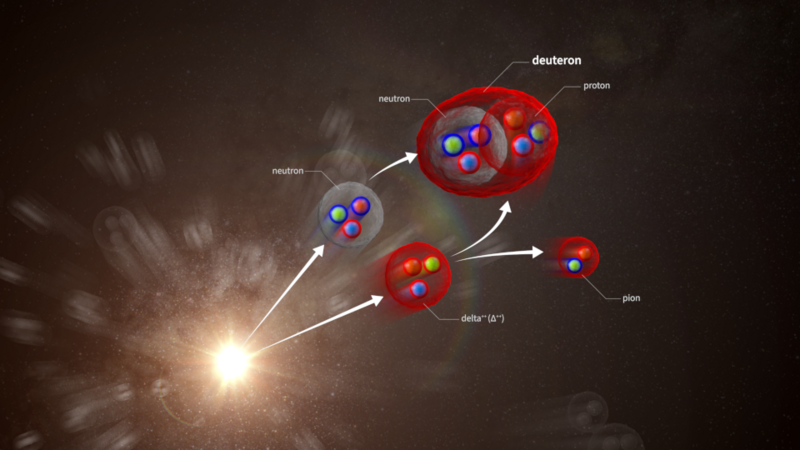
The result: The protons and neutrons necessary for the formation of deuterons are released during the decay of very short-lived, highly energetic particle states (so-called resonances) and then bind together. The same holds true for their antimatter counterparts. The findings were published in the renowned journal Nature.
In proton collisions at the Large Hadron Collider (LHC) at CERN, temperatures arise that are more than 100,000 times hotter than the center of the Sun. Until now, it had been entirely unclear how fragile particles such as deuterons and antideuterons could survive under these conditions. In such an environment, light atomic nuclei like the deuteron – consisting of just one proton and one neutron – should in fact disintegrate immediately, since the binding force that holds them together is comparatively weak. Yet such nuclei had repeatedly been observed. It is now clear: about 90 percent of the observed (anti)deuterons are produced through this mechanism.
Better understanding of the universe
TUM particle physicist Prof. Laura Fabbietti, a researcher in the SFB1258 and PI at the ORIGINS Cluster of Excellence, emphasizes: “Our result is an important step toward a better understanding of the ‘strong interaction’ – that fundamental force that binds protons and neutrons together in the atomic nucleus. The measurements clearly show: light nuclei do not form in the hot initial stage of the collision, but later, when the conditions have become somewhat cooler and calmer.”
Dr. Maximilian Mahlein, a researcher at Laura Fabbietti’s Chair for Dense and Strange Hadronic Matter at the TUM School of Natural Sciences, explains: “Our discovery is significant not only for basic research. Light atomic nuclei also form in the cosmos – for example in interactions of cosmic rays. They could even provide clues about the still-mysterious dark matter. With our new findings, models of how these particles are formed can be improved and cosmic data interpreted more reliably.”
Further information:
CERN (Conseil Européen pour la Recherche Nucléaire) is the world’s largest research center for particle physics. It is located on the border between Switzerland and France near Geneva. Its centerpiece is the LHC, a 27-kilometer-long underground ring accelerator. In it, protons collide at nearly the speed of light. These collisions recreate conditions similar to those that existed just after the Big Bang – temperatures and energies that do not occur anywhere in everyday life. Researchers can thus investigate how matter is structured at its most fundamental level and which natural laws apply there.
Among the experiments at the LHC, ALICE (A Large Ion Collider Experiment) is specifically designed to study the properties of the so-called strong interaction – the force that holds protons and neutrons together in atomic nuclei. ALICE acts like a giant camera, capable of precisely tracking and reconstructing the countless particles created in each collision. The aim is to reconstruct the conditions of the universe’s earliest fractions of a second – and thereby better understand how a soup of quarks and gluons first gave rise to stable atomic nuclei and ultimately to matter.
TUM press release
SFB1258 press release
Publication:
The ALICE Collaboration, “Observation of deuteron and antideuteron formation from resonance-decay nucleons”, Nature, 2025
Contact:
Prof. Dr. Laura Fabbietti
Technical University Munich / Excellence Cluster ORIGINS
email: laura.fabbietti(at)ph.tum.de
