LearningMatters: Smart Slime Molds
For many seriously ill people, artificial organs offer great hope. Unfortunately, however, the supply of nutrients to the cells within these organs is usually inadequate because, unlike in natural organs, the network of blood vessels does not learn how to adapt and develop optimally.
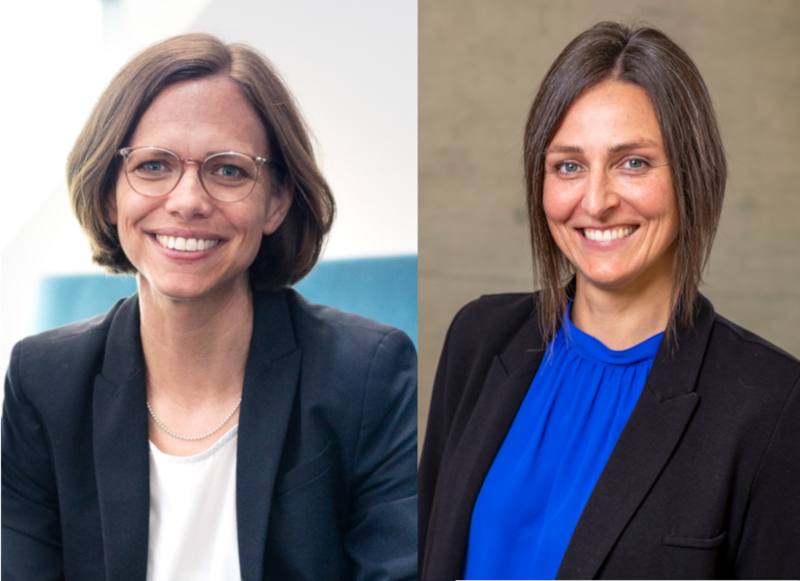
In the LearningMatters project (short for "Learning Matters! The physics of continual learning in biological and soft matter"), Karen Alim and her team wants to gain a fundamental understanding of how matter learns and then teach this to artificial blood vessels, among other things. To do this, she is relying on the remarkable abilities of slime molds. These single-celled organisms are known for solving complex problems, such as finding the shortest path through a maze, even without a brain. They will help Karen Alim identify the physical principles by which information is disseminated, stored, and processed in life without neurons.
Karen Alim's vision is to usher in an era of adaptive matter - matter that literally feels and learns from its past. Her research was already funded with an ERC Starting Grant in 2020. She is a principal investigator in Research Unit E (From Planets to Darwinial Evolution and Life) at the ORIGINS Cluster of Excellence and is also a member of the newly funded BioSysteM Cluster of Excellence.
PIRATES: Innovation for detecting dark matter
According to current knowledge, around 25 percent of the universe consists of dark matter, while the familiar, visible matter accounts for only about 5 percent. Several experiments worldwide are currently attempting to detect the mysterious particles of dark matter. One of these experiments, DAMA/LIBRA, claims to have detected dark matter. However, confirmation by independent experiments is still lacking.
In the PIRATES project (short for "Prospects In Rare-event-searches with Advanced Transition Edge Sensors"), Karoline Schäffner and her team aim to verify the controversial results with the COSINUS experiment in the Gran Sasso underground laboratory. They are using the same detector material as the original, but with significantly more sensitive superconducting quantum sensors – which are to be continuously developed and improved. The goal is to make the production of such sensors reliable and scalable in order to manufacture large sensor arrays in the future. In addition, the group will test novel crystalline materials that could significantly increase the sensitivity of future detectors and thus overcome previous limitations.
Karoline Schäffner has been leading a Max Planck research group on dark matter since 2019 and is a principal investigator in Research Unit B (Particles and the Cosmos) at the ORIGINS Cluster of Excellence. She recently received a grant from the Max Planck Society's Lise Meitner Excellence Program. Since October 2025, she has also been a professor of Experimental Dark Matter and Neutrinos at the Technical University of Munich.
ERC press release
TUM press release
MPP Pressemeldung
Contact
Prof. Dr. Karen Alim
Technical University of Munich
email: k.alim(at)tum.de
Prof. Dr. Karoline Schäffner
Max Planck Institute for Physics / Technical University of Munich
email: karoline.schaeffner(at)mpp.mpg.de
