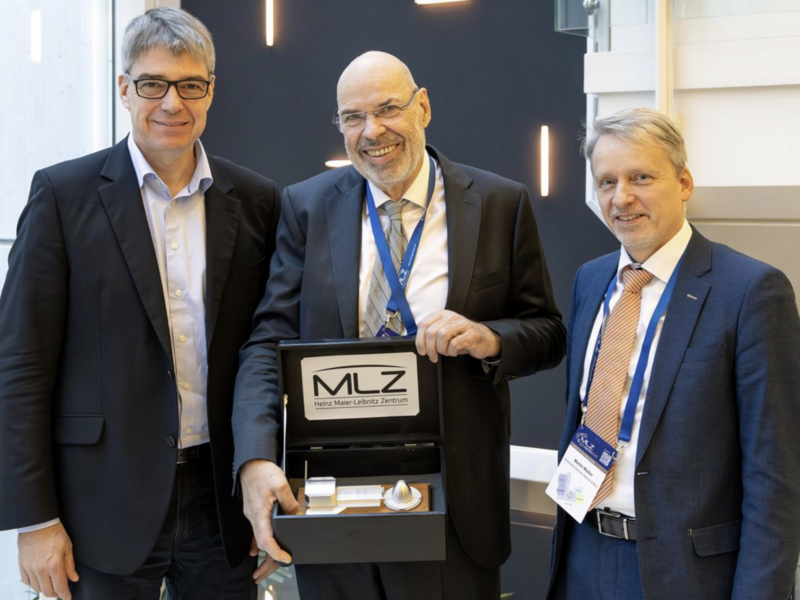
The award was presented to him by Prof. Christian Pfleiderer and Prof. Martin Müller, the scientific directors of the MLZ, during the MLZ User Meeting at the end of 2025. Laudator Christian Pfleiderer recounts his early years at the Technical University of Munich, where, as a newly appointed professor, he received valuable advice from Stephan Paul and jointly conducted final examinations. “I was somewhat relieved that I did not have to answer these questions myself,” Christian Pfleiderer admits.
“Shaped the entire community”
Stephan Paul joined the FRM II and the MLZ very early on. From 2008 to 2010, he was a member of the Instrumentation Council, and from 2011 to 2020, he was a member of the MLZ Coordination Council “from day one,” as laudator Christian Pfleiderer says. “Stephan Paul is someone who has shaped an entire community. He is the representative for particle physics with neutrons,” says Christian Pfleiderer, praising his colleague.
Getting instruments up and running
In his subsequent plenary lecture, Stephan Paul expresses his gratitude for the “tremendous honor” of receiving the award. “I took the research reactor to my heart from day one and was actively involved in getting the instruments at FRM II up and running,” he adds.
How did antimatter disappear?
Then he moves straight on to his topic: neutrons in particle physics and ultra-cold neutrons in particular: “It's great fun doing research with neutrons,” says Stephan Paul, revealing his passion right at the start. You can “run up to” ultra-cold neutrons because they only travel at a speed of 5 meters per second. And according to Stephan Paul, these neutrons are extremely important for understanding how the universe evolved after the Big Bang. Were there more than three spatial dimensions? Why is there less antimatter than matter?
Ultracold neutron source
All of this can be investigated with the scientific neutron instruments developed and maintained by Stephan Paul's chair: the planned ultracold neutron source, which will supply two instruments.
When presenting the award, a miniature model of the FRM II reactor, Stephan Paul elicits laughter from the approximately 250 scientific guests: “Wow, where's the power button?”
More information about Stephan Paul:
After studying physics at the University of Bonn, Stephan Paul earned his doctorate at the University of Heidelberg. He conducted research at the Max Planck Institute for Nuclear Physics in Heidelberg and was a research fellow at CERN, where he remains chairman of the COMPASS Collaboration Board to this day. In 1997, Stephan Paul was appointed to the TUM Chair of Experimental Physics I. His chair researches fundamental symmetries in particle physics. In addition to his scientific contributions, one of Stephan Paul's greatest successes at TUM is the coordination of the Universe Cluster of Excellence, now called Origins, which has been successful four times in the Germany-wide Excellence Initiative. He coordinated this cluster from 2006 to 2025. For his services, he received the Federal Cross of Merit in 2010 and the Heinz Maier-Leibnitz Medal from TUM in 2006, among other honors.
