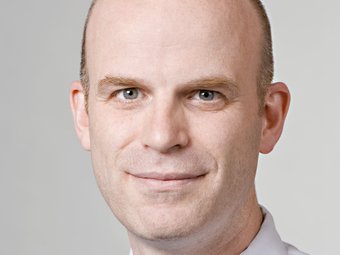
10/29/2021 ORIGINS mourns the untimely loss of Prof. Dr. Shawn Bishop. After a long and serious illness he passed away on 19th October 2021, just a few days before his 50th birthday. Shawn Bishop was very involved in the Universe cluster of excellence, which is the predecessor cluster of ORIGINS.
more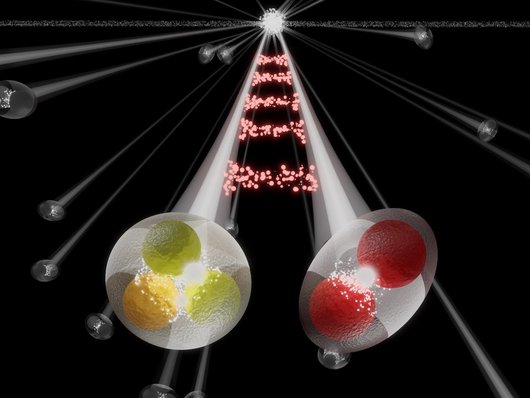
10/26/2021 The ALICE Collaboration, including Emma Chizzali of Laura Fabbietti’s group at the TUM, have demonstrated for the first time that the strong interaction between a proton and φ meson is attractive. These results are not only fundamental to nuclear and particle physics but also important to the understanding of the properties and composition of neutron stars, the densest objects in our universe.
more
08/10/2021 Dr. Lorenzo Tancredi will take up the ORIGINS-supported professorship in Theoretical Particle Physics on September 1, 2021. His main research interest is in theoretical high-energy physics, in particular in relation to the Large Hadron Collider (LHC) at CERN.
more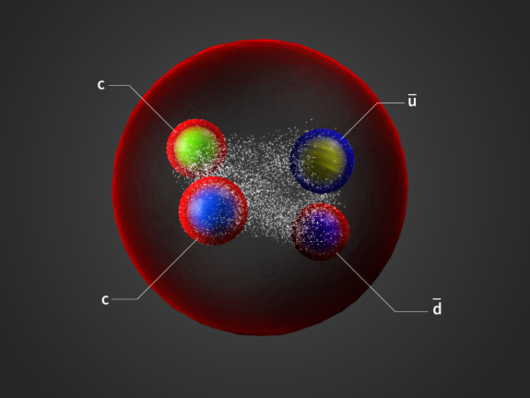
07/29/2021 The LHCb collaboration at CERN, and instrumentally our new ORIGINS Fellow Mikhail Mikhasenko, previously a Fellow at CERN, has discovered a new class of hadronic matter, double-heavy tetraquarks, labelled as Tcc+, with overwhelming statistical significance. In fact, this is the longest-living exotic particle ever observed, and the first to contain two heavy quarks and two light antiquarks.
more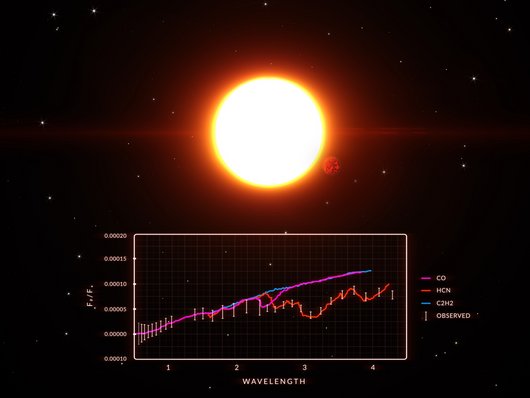
07/08/2021 The Excellence Cluster ORIGINS has become a founding member of the Twinkle mission. Lift-off for the new space telescope is planned for 2024. The instrument will give astrophysicists at the LMU the first reliable data on the chemical composition of the atmospheres of exoplanets – and may also shed light on the prospects for life on these worlds.
more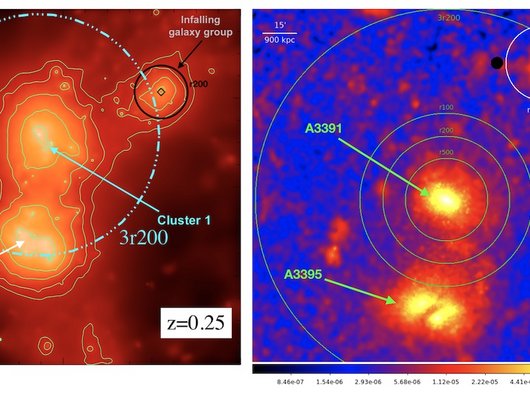
06/28/2021 What steers galaxies, or whole ensembles of galaxies - so-called galaxy clusters? Aren’t they surrounded by vast empty space? Could the recently discovered long hot interconnecting gas filaments play a role? Although cosmological models and simulations predicted these structures and the role they may play, the observational confirmation of their existence, using the x-ray space telescope eROSITA, is quite recent. Further snapshots of simulations compared to the observations unveil a galaxy group speeding along such a long gas filament, on a collision course with other…
more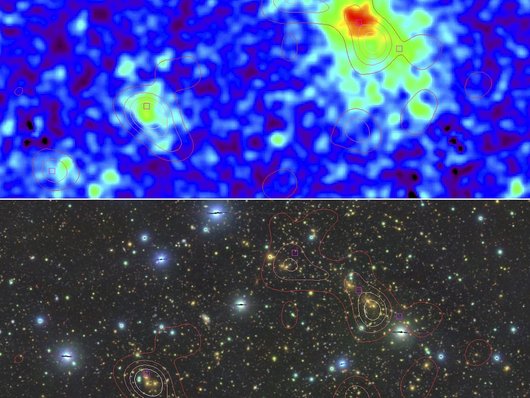
06/28/2021 As announced during the 2021 meeting of the European Astronomical Society, the German eROSITA collaboration will release the first set of data taken with the eROSITA X-ray telescope onboard the SRG observatory. For the first time, astronomers throughout the world will have the chance to download and analyse data from this new powerful telescope. The Early Data Release will be accompanied by the publication of 35 eROSITA science papers by the German eROSITA Consortium on the arXiv preprint server, with these and more to be published in a forthcoming special issue of the…
more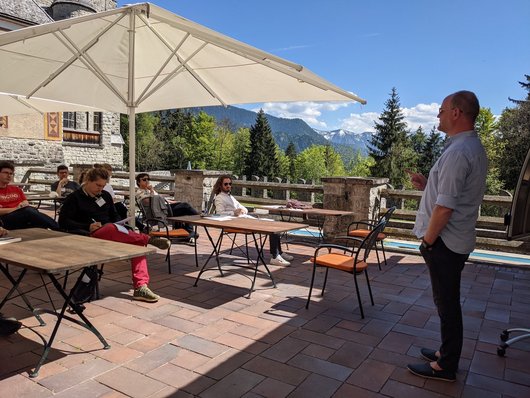
06/17/2021 For the first time since the beginning of the pandemic, the ORIGINS PhD Days could take place on site – this year from May 30 to June 2 at Ringberg Castle, a conference venue of the Max Planck Society. During the three-day workshop, the 18 PhD students got to know each other and exchanged ideas about their research in stimulating discussions.
more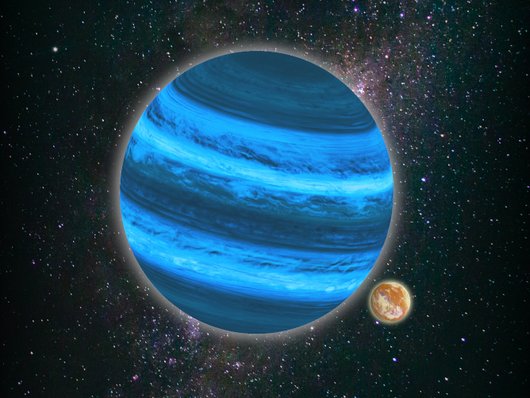
06/09/2021 The moons of planets that have no parent star can possess an atmosphere and retain liquid water. Astrophysicists at LMU have calculated that such systems could harbor sufficient water to make life possible – and sustain it.
more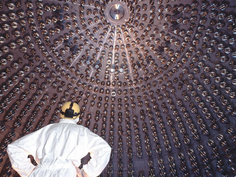
05/31/2021 For their groundbreaking observations of solar neutrinos, with which the fusion reactions inside the sun could be experimentally proofed for the first time, the team of the Borexino collaboration receives the prestigious Giuseppe and Vanna Cocconi Prize. Every two years, the European Physical Society awards it to an outstanding discovery in astro-particle physics and cosmology of the past 15 years. TUM emeritus Prof. Franz von Feilitzsch, Prof. Lothar Oberauer and Prof. Stefan Schönert, all working at the Chair of Experimental Astroparticle Physics of the Technical…
more