When a new point of light suddenly appears in the sky, every hour often counts for astronomers. Many of the most energetic events in the Universe flare up only briefly. These include supernovae and kilonovae, gamma-ray bursts and the visible counterparts of gravitational-wave signals.
These short-lived phenomena are known as transients. Specialised telescopes detect them and alert observatories around the world. A race against time then begins: researchers must gather as much information as possible before the signal disappears again.
1,600 spectra at once
In August 2026, a German American team installed the Spectral Energy Distribution Machine (SEDM) on the 2.1-metre Fraunhofer Telescope at Wendelstein Observatory, Germany’s largest optical telescope. The telescope’s English name is ‘Fraunhofer Telescope Wendelstein’ (FTW). This is why the instrument is called SEDM-FTW at this site.
SEDM-FTW was developed and built at the California Institute of Technology (Caltech) in Pasadena and is available to the University Observatory on loan. At its heart is an integral field unit (IFU). It records a separate spectrum for each of around 1,600 image points. This makes it possible to examine particularly efficiently how the energy of the observed light is distributed across different wavelengths. This provides insight into the physical processes behind a cosmic event.
‘What we are ultimately seeing here are events unfolding in rapid succession in the lives of stars. In these moments, a large proportion of the elements and “stardust” essential for life in the Universe is created,’ says Daniel Grün, Professor of Astrophysics at LMU’s University Observatory. ‘SEDM-FTW gives us a more detailed picture of these processes, which we hope will help solve some mysteries.’
By helicopter to the telescope
To use SEDM-FTW at Wendelstein, the team had to adapt it to its new location. One particular challenge is the nearby transmission facility operated by Bayerischer Rundfunk, the Bavarian broadcaster. Specially developed electromagnetic shielding protects the instrument from interference.
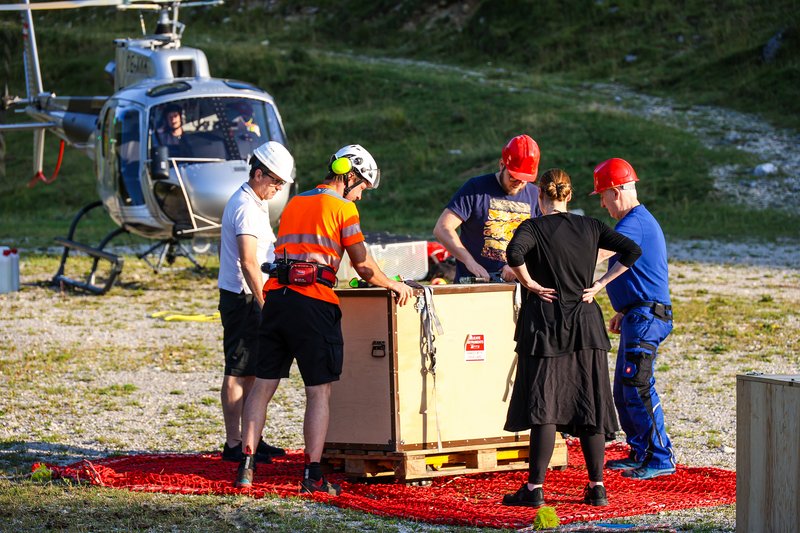
After several weeks of laboratory work in Munich, SEDM-FTW first travelled towards Wendelstein by lorry, completing the final leg by helicopter. At the summit, LMU staff worked with colleagues from the United States to mount the instrument on the telescope.
‘Installing a new instrument on a telescope is always a technical and organisational challenge,’ says Dr Hanna Kellermann, a researcher at LMU’s Wendelstein Observatory. ‘That makes the joy all the greater when the first images show that everything is working.’
New opportunities for transient astronomy
The ORIGINS Cluster of Excellence funded the necessary work on the spectrograph and the observatory. With SEDM-FTW, researchers can respond more quickly to newly detected events in the sky and track their early development.
Final tests and calibration measurements are currently under way. SEDM-FTW is expected to begin scientific operations soon. ‘I am particularly looking forward to the new opportunities that SEDM-FTW, in combination with our other instruments, will offer us to better understand the early development of high-energy events in the cosmos,’ says Malte Busmann, a doctoral researcher at LMU’s University Observatory.
Contact:
Prof. Dr. Daniel Grün
Ludwig-Maximilians-Universität München / Excellence Cluster ORIGINS
email: Daniel.Gruen(at)lmu.de
