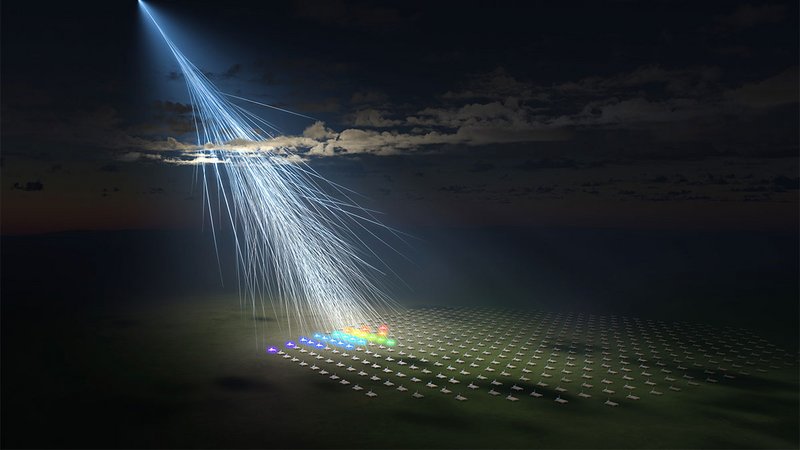
Cosmic rays are extremely fast, charged particles that travel through space at nearly the speed of light. The Amaterasu particle was detected in 2021 by the Telescope Array experiment in the USA. It is the second-highest-energy cosmic ray ever observed, carrying around 40 million times more energy than particles accelerated at the Large Hadron Collider. Such particles are exceedingly rare and thought to originate in some of the most extreme environments in the Universe.
The arrival direction of the Amaterasu particle appeared to point toward the Local Void, a region of space with few known galaxies or energetic objects capable of producing such particles - posing a puzzle for scientists.
Beyond an ‘empty’ region of space
In their study, Francesca Capel and Nadine Bourriche show that the particle’s origin does not have to be confined to a single empty region of the Universe. Instead, it may lie within a broader range of nearby cosmic environments. “Our results suggest that, rather than originating in a low-density region of space like the Local Void, the Amaterasu particle is more likely to have been produced in a nearby star-forming galaxy such as M82,” says Nadine Bourriche.
These conclusions are based on a novel, data-driven method developed by the researchers to trace the particle’s possible path through space. Using detailed three-dimensional simulations of cosmic-ray propagation and their interaction with magnetic fields, the study applies a statistical technique known as Approximate Bayesian Computation. “This approach works by comparing the results of realistic, physics-based simulations with actual observational data to infer the most probable source locations,” Bourriche explains.
New analytical groundwork for data-driven searches
By combining advanced simulations with modern statistical methods, the researchers were able to generate probability maps showing where the particle could realistically have originated. The framework developed in this study sets important milestones for future research. It provides a powerful tool to guide observations and sharpen the search for the cosmic sources capable of accelerating particles to such extreme energies. “Exploring ultra-high-energy cosmic rays helps us to better understand how the Universe can accelerate matter to such energies, and also to identify environments where we can study the behavior of matter in such extreme conditions”, Francesca Capel, leader of the group “Astrophysical Messengers” at the MPP says. “Our goal is to develop advanced statistical analysis methods to exploit the available data to its full potential and gain a deeper understanding of the possible sources of these energetic particles.” These new approaches focus on complementing existing efforts by enabling a closer connection between theory and data and combining information from different observations.
Publication:
Nadine Bourriche, Francesca Capel: Beyond the Local Void: A Data-driven Search for the Origins of the Amaterasu Particle, Astrophys.J. 997 (2026) 2, 264 https://iopscience.iop.org/article/10.3847/1538-4357/ae2c89
Press Release Max Planck Institute for Physics
Contact:
Dr. Francesca Capel
Max Planck Institute for Physics / Excellence Cluster ORIGINS
email: francesca.capel(at)mpp.mpg.de
Nadine Bourriche
Max Planck Institute for Physics / Excellence Cluster ORIGINS
email: nadine.bourriche(at)mpp.mpg.de
