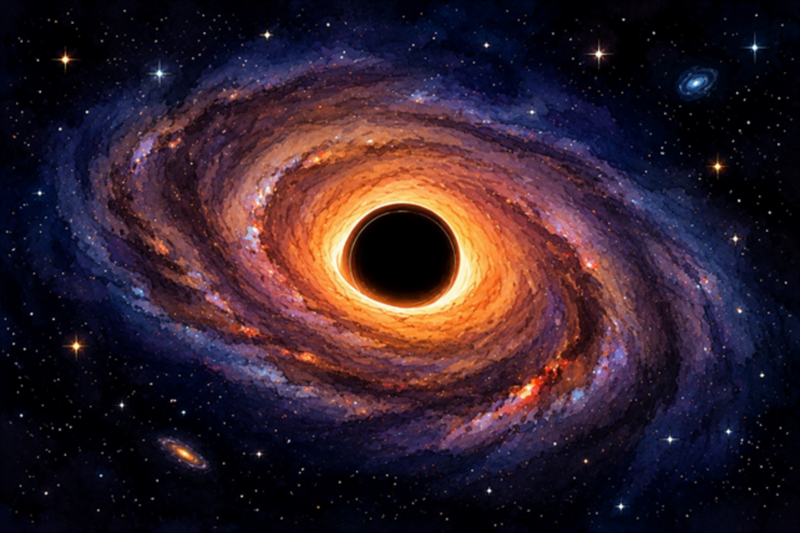
The study, led by ORIGINS researchers at the Max Planck Institute for Extraterrestrial Physics (MPE), is based primarily on data from the eROSITA X-ray telescope. The team examined 22,079 quasars—active galactic nuclei in which matter falls onto a supermassive black hole, generating intense radiation—in the sky region.
“Astronomers had assumed that central black holes always grow in close coupling with their galaxies. Our results show that this is not always the case,” says Johannes Buchner of the MPE, who led the study together with international partners
The study's findings in a nutshell:
- Black Holes and Galaxies: Eight black holes that were studied are extremely massive compared to their host galaxies and grew disproportional to the galaxies themselves.
- Unusual Mass Ratios: The ratio of black hole mass to stellar mass in the galaxies is at least 1 to 20, which is significantly higher than the typical value of about 1 to 200.
- Black Hole Growth Phase: The black holes are currently accreting matter at a rate that could double their mass within about one billion years.
- Future Research: Additional eROSITA data and high-resolution observations will help determine how common these systems are and how the host galaxies evolve.
“These results are exciting and unexpected. We had assumed that galaxies and their central black holes grow closely connected to one another. These observations indicate that black holes can become extremely massive relative to their galaxies, apparently to a large extent independently of the evolution of the stellar population. This challenges us to rethink how black holes grow over cosmic history,” says Roberto Maiolino, a professor at the University of Cambridge, who was not involved in the study.
The eight quasars are likely to represent only the active, observable part of a larger population. Inactive or heavily obscured black holes cannot be identified as easily using the method applied here. Further eROSITA data and spectroscopic surveys will help determine how common these systems are.
The key open question is how the black holes gained so much mass without a corresponding increase in the stellar mass of their host galaxies. High-resolution observations will show whether the galaxies are still forming stars, how they are structured and how gas reached their central black holes over extended periods..
Full press release from the MPE
Original Publication: Buchner, J., I. Gauger, Q. Wu et al.: A large population of overmassive black hole quasars at z=0.3-0.8 revealed by eROSITA.
Contact:
Dr. Johannes Buchner
Postdoc High-Energy Astrophysics am MPE / Exzellenzcluster ORIGINS
email: jbuchner(at)mpe.mpg.de
Prof. Dr. Kirpal Nandra
Director of the High-Energy Astrophysics am MPE / Exzellenzcluster ORIGINS
email: knandra(at)mpe.mpg.de
