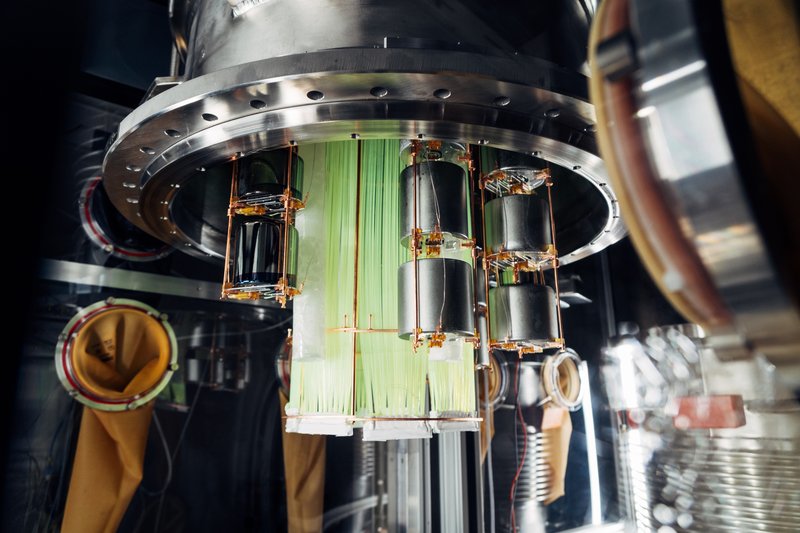
Why does the universe consist of matter – rather than equal amounts of matter and antimatter? This fundamental question is at the heart of LEGEND‑1000, a major international experiment advanced by TUM together with MPIK. At the Gran Sasso underground laboratory in Italy, researchers are searching for a process known as neutrinoless double-beta decay – an extremely rare phenomenon that has never been observed. Detecting it would show that neutrinos are their own antiparticles and could provide crucial clues to how the excess of matter emerged from which today’s universe evolved after the Big Bang.
A Next-Generation Experiment
With 1,000 kilograms of highly sensitive germanium detectors, exceptional energy resolution, and an ultra-low background environment, LEGEND‑1000 ranks among the world’s most ambitious astroparticle physics experiments. At the same time, the research infrastructure will open up new opportunities in the search for dark matter, the study of solar and supernova neutrinos, and the exploration of phenomena beyond the Standard Model of particle physics.
The German Science and Humanities Council has now recommended implementing Germany’s contribution to LEGEND‑1000 as part of the national prioritization process for large-scale research infrastructures conducted by the Federal Ministry of Research, Technology and Space (BMFTR). The recommendation is based on a scientific review that attests to the project’s outstanding importance for particle and nuclear physics as a whole. In its statement, the Council emphasizes that the expected insights extend far beyond neutrino physics and address foundational questions about our understanding of the universe.
Scientific Impact and Technological Innovation
It also highlights the project’s technological momentum: the demanding experimental setup will advance the development of highly sensitive detectors, cryogenic systems, and ultra-low-background materials, enabling applications in areas such as environmental monitoring, radiation detection, medical imaging, and quantum computing. German and European companies are already involved in developing key components.
News of the TUM School of Natural Sciences
Contacts:
Prof. Dr. Stefan Schönert
Chair of Experimental & Astroparticle Physics
email: schoenert(at)ph.tum.de
Prof. Dr. Susanne Mertens
Director Max-Planck-Institut für Kernphysik
TUM Distinguished Affiliated Professor
email: susanne.mertens(at)mpi-hd.mpg.de
