
05/11/2022 The bubbling surface of massive giant stars causes their observable positions on the sky to wobble. An international team lead by astrophysicists at the ORIGINS Excellence Cluster has now performed detailed simulations of the gas motions in the atmospheric layers of these stars and compared these with high-quality data of the Perseus stellar cluster. They find that the surface structures could indeed account for a large part of the measurement uncertainty in the observations.
more
02/14/2022 The international KArlsruhe TRItium Neutrino Experiment (KATRIN), located at Karlsruhe Institute of Technology (KIT), has broken an important "barrier" in neutrino physics which is relevant for both particle physics and cosmology. Based on data published in the prestigious journal Nature Physics, a new upper limit of 0.8 electronvolt (eV) for the mass of the neutrino has been obtained. This first push into the sub-eV mass scale of neutrinos by a model-independent laboratory method allows KATRIN to constrain the mass of these "lightweights of the universe" with unprecedented…
more
01/03/2022 In April 2017 the Event Horizon Telescope (EHT) observed the super-massive black hole M87* and provided a first image of its shadow that went around the world. Researchers at the Max Planck Institute for Astrophysics have now reconstructed a video of the immediate surroundings of a black hole from the same underlying data. This not only confirms previous findings, it also hints at new structures and dynamics in the gas disk around the black hole.
more
12/14/2021 ORIGINS scientist and Max Planck Institute for Astrophysics (MPA) Director Eiichiro Komatsu has been selected as one of the recipients of this year's Inoue Prize for Science. He is recognized for his work to study the physics of the early Universe as a researcher with remarkable achievements in the natural and fundamental sciences.
more
11/19/2021 The German Physical Society (DPG) awards the Stern-Gerlach Medal, the DPG's highest award for excellent achievements in experimental physics, to ORIGINS scientist Frank Eisenhauer of the Max Planck Institute for Extraterrestrial Physics (MPE). Frank Eisenhauer is honoured for his "pioneering work in high-resolution infrared astronomy, which has revolutionized spectroscopic as well as astrometric studies."
more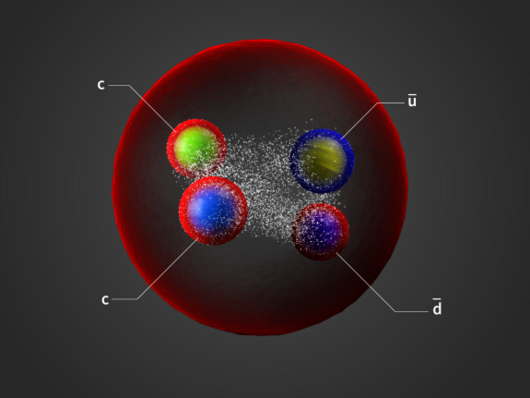
07/29/2021 The LHCb collaboration at CERN, and instrumentally our new ORIGINS Fellow Mikhail Mikhasenko, previously a Fellow at CERN, has discovered a new class of hadronic matter, double-heavy tetraquarks, labelled as Tcc+, with overwhelming statistical significance. In fact, this is the longest-living exotic particle ever observed, and the first to contain two heavy quarks and two light antiquarks.
more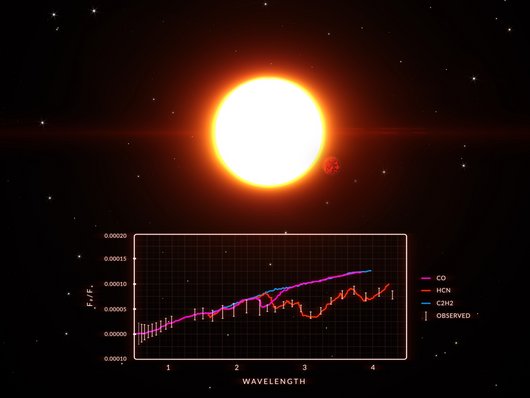
07/08/2021 The Excellence Cluster ORIGINS has become a founding member of the Twinkle mission. Lift-off for the new space telescope is planned for 2024. The instrument will give astrophysicists at the LMU the first reliable data on the chemical composition of the atmospheres of exoplanets – and may also shed light on the prospects for life on these worlds.
more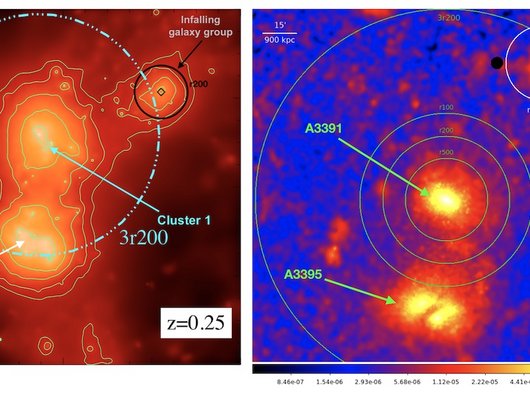
06/28/2021 What steers galaxies, or whole ensembles of galaxies - so-called galaxy clusters? Aren’t they surrounded by vast empty space? Could the recently discovered long hot interconnecting gas filaments play a role? Although cosmological models and simulations predicted these structures and the role they may play, the observational confirmation of their existence, using the x-ray space telescope eROSITA, is quite recent. Further snapshots of simulations compared to the observations unveil a galaxy group speeding along such a long gas filament, on a collision course with other…
more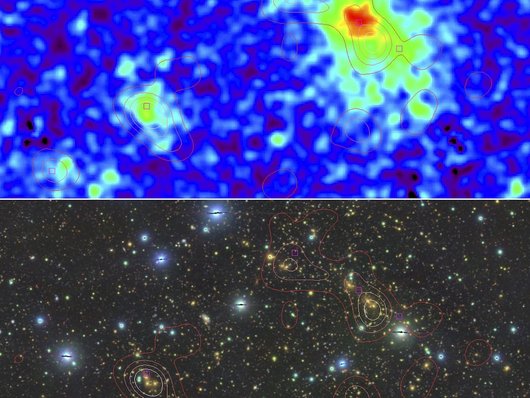
06/28/2021 As announced during the 2021 meeting of the European Astronomical Society, the German eROSITA collaboration will release the first set of data taken with the eROSITA X-ray telescope onboard the SRG observatory. For the first time, astronomers throughout the world will have the chance to download and analyse data from this new powerful telescope. The Early Data Release will be accompanied by the publication of 35 eROSITA science papers by the German eROSITA Consortium on the arXiv preprint server, with these and more to be published in a forthcoming special issue of the…
more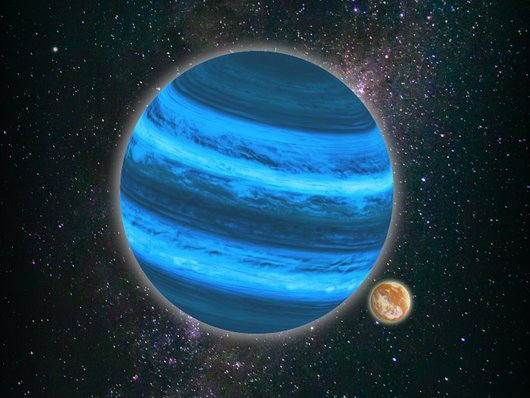
06/09/2021 The moons of planets that have no parent star can possess an atmosphere and retain liquid water. Astrophysicists at LMU have calculated that such systems could harbor sufficient water to make life possible – and sustain it.
more
