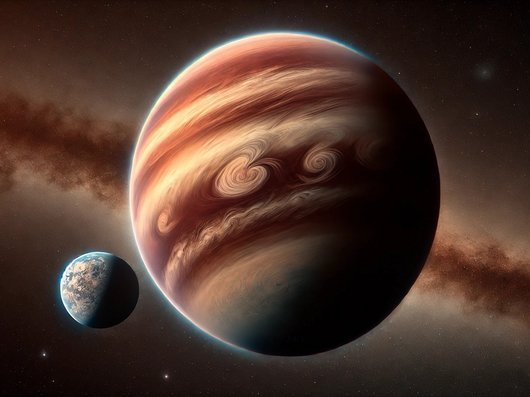
03/09/2026 Liquid water is considered essential for life. Surprisingly, however, stable conditions that are conducive to life could exist far from any sun. A research team from the Excellence Cluster ORIGINS at LMU and the Max Planck Institute for Extraterrestrial Physics (MPE) has shown that moons around free-floating planets can keep their water oceans liquid for up to 4.3 billion years by virtue of dense hydrogen atmospheres and tidal heating – that is to say, for almost as long as the Earth has existed and sufficient time for complex life to develop.
more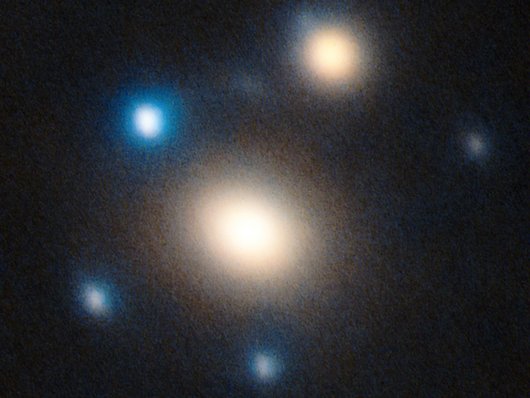
02/19/2026 That the Universe is expanding has been known for almost a hundred years now, but how fast? The exact rate of that expansion remains hotly debated, even challenging the standard model of cosmology. A research team at the Technical University of Munich (TUM), the Ludwig Maximilians University (LMU) and the Max Planck Institutes for Astrophysics (MPA) and for Extraterrestrial Physics (MPE) has now imaged and modelled an exceptionally rare supernova nicknamed SN Winny that could provide a new, independent way to measure how fast the Universe is expanding. The project was…
more


