
The ERC Advanced Grant is one of the EU’s most prestigious research grants and supports leading international scientists in carrying out particularly ambitious and high-risk projects. In total, the ERC selected 319 top researchers in Europe, who will receive funding totalling 838 million euros under the EU’s ‘Horizon Europe’ programme.
Finding New Physics from the Polarized Light of the Cosmic Microwave Background
Some of the most pressing questions in cosmology and fundamental physics today are the physical nature of dark matter, dark energy, and cosmic inflation. Eiichiro Komatsu and his team will explore an entirely new approach to elucidate their nature: a violation of parity symmetry, the symmetry of a physical system under inversion of spatial coordinates. They will use the polarization of the cosmic microwave background (CMB) to probe the parity violation.
If the physics behind dark matter and dark energy breaks parity symmetry, their coupling to photons rotates the plane of linear polarization as the CMB photons have traveled for 14 billion years. This effect is known as “cosmic birefringence”. A tantalizing hint of such a signal using CMB data from the WMAP and Planck missions already has been reported (see https://www.mpa-garching.mpg.de/1137699/hl202602 and https://www.mpa-garching.mpg.de/1055454/hl202206 ).
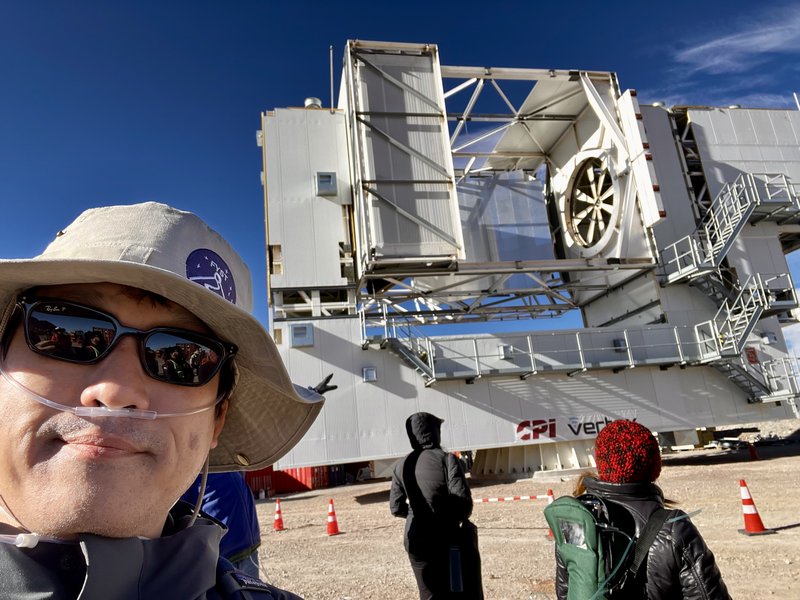
With the ERC-funded research programme, the team will analyze existing and upcoming data from the Fred Young Submillimetre Telescope to improve measurements and study the origin of cosmic birefringence. If the physics behind cosmic inflation also breaks the parity symmetry, the primordial gravitational waves could become “chiral” and only one of the circular polarization states of the gravitational waves is excited. This will leave imprints not only on the CMB but also on direct detection experiments of gravitational waves.
Eiichiro Komatsu
Eiichiro Komatsu’s work has been recognized with numerous awards including the Gruber Cosmology Prize in 2012, The American Astronomical Society Lancelot M. Berkeley - New York Community Trust Prize for Meritorious Work in Astronomy by the American Astronomical Society in 2013, the Chushiro Hayashi Prize by the Astronomical Society of Japan in 2015, the Breakthrough Prize in Fundamental Physics in 2017, the Inoue Prize for Science in 2021, and the Nishina Memorial Prize, the most prestigious Japanese physics award, in 2022. That same year, the University of Michigan’s Department of Physics invited him to give the prestigious Ta-You Wu Distinguished Lecture.
Lensing cosmic fireworks: Constraining the Hubble constant, supernova Ia progenitors, and emissions of tidally disrupted stars near black holes
Imagine a universe where we can predict a supernova (SN) before it happens. LENS-ON-FIRE will use strong gravitational lensing as a tool to open a unique window into cosmology, supernovae and black holes. In gravitational lensing, massive foreground objects, such as a galaxy or a whole galaxy cluster, warp spacetime, bending the paths of light from distant sources. In the strong lensing regime, multiple images of a flare can appear at different times due to the varying lengths of the optical paths. By detecting the first image(s) and carefully modelling the distribution of the foreground mass distribution, the team is able to predict the appearance of subsequent images, using the strong lensing effect like a time machine.
Strong lensing of supernovae, which show multiple images of the same stellar explosion appearing at different times/locations around foreground lens galaxies, provides a direct way to measure the Hubble constant (H0), the current expansion rate of our Universe. Currently, there is a tension in measurements of the Hubble constant between observations from the early universe and the local supernovae distance ladder. The new approach will provide an independent measurement of H0 with a precision on the order of 1%, allowing us to test physics beyond the standard cosmological model.
By exploiting the time delays between lensed supernova images as a cosmic time machine, the next occurrence (of the same event) can be observed in detail in its entirety for the first time in history. The unprecedented early-phase spectra of supernovae will reveal progenitors that have been long-debated.
Flares in distant sources can also be due to tidal disruption events (TDEs) of stars, which happen when a star gets too close to a supermassive black hole and is being ripped apart. Strong lensing and microlensing of TDEs can constrain the size of the emission region, providing insight into the physical emission mechanism and enabling inferences about black hole properties.
Sherry Suyu
Sherry Suyu became a Research Group Leader at the Max Planck Institute for Astrophysics (MPA) in 2016 and an Assistant Professor at TUM, as part of the Max Planck@TUM programme. She is now an Associate Professor at TUM, and a Max Planck Fellow at MPA. She received the Significant Research Achievements award of Academia Sinica in 2013, a European Research Council Consolidator Grant in 2017, the Emmy Noether Visiting Fellowship of the Perimeter Institute in Canada in 2018, the Lancelot M. Berkeley − New York Community Trust Prize for Meritorious Work in Astronomy from the American Astronomical Society in 2021, the NCU-Delta Young Astronomer Lectureship Award of Taiwan and the Heinz Maier-Leibnitz Medal of the Technical University of Munich in 2022. Her teaching has also been recognized: in 2024, she received the Golden Chalk teaching award for the best bachelor’s physics lectures from students of the Technical University of Munich.
Contakt:
Prof. Komatsu Eiichiro
Max-Planck-Institut für Astrophysik / Exzellenzcluster ORIGINS
email: komatsu(at)mpa-garching.mpg.de
Prof. Sherry Suyu
Max-Planck-Institut für Astrophysik / Technische Universität München
email: suyu(at)mpa-garching.mpg.de
